How our neighbors in Aurora are helping Boulder heal
“It takes a community to heal a community” – Heather Dearman, Aurora 7/20 Memorial Foundation
When a pregnant Ashley Moser took her 6-year-old daughter Veronica to the movies on July 20, 2012, she was expecting a fun Friday night out in Aurora.
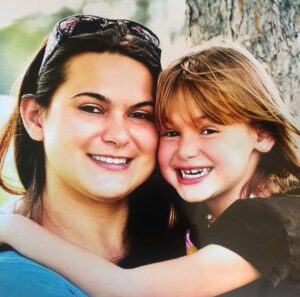
Ashley with Veronica
That changed in an instant when a gunman opened fire on movie-goers, killing little Veronica and 11 others. Seventy people were injured, including Ashley, who miscarried a week after the attack.
Today, Ashley is a paraplegic confined to a wheelchair.
“You’re never going to be the same,” Ashley’s cousin Heather Dearman said.
Heather works for the city of Aurora and is on the board of directors of the 7/20 Memorial Foundation, whose members are paying forward the help – and hope – they received from strangers.
“People from all over the country were sending banners to the city with notes of love and support on them and everyday I’d walk into work and see all the things people were sending from all over,” Heather said. “It meant so much to me and it kept me strong and made me realize there was more love in the world than hate. It definitely did start the healing process for me.”
One of the things Heather learned is that everyone heals differently.
“I know, for example, that my cousin Ashley probably couldn’t process it at the time but years later, seeing those cards and letters, helped her heal in the long run,” she said. “After the media goes away, months and years later you feel like you’re forgotten about. But those notes and that love and support is still there.”
That’s why the “Paper Crane Peace Project” has become integral to the 7/20 foundation’s mission.
‘We fashion origami paper cranes into wreaths and give them to victims’ families,” Heather said. “The cranes contain words of peace and love.”
The foundation is collecting the cranes through June to make 11 wreaths, one for King Soopers and one each for the victim’s family.

A completed paper crane wreath.
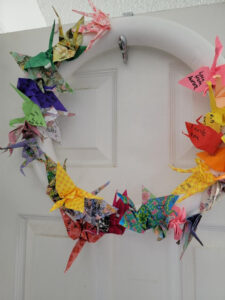
A paper crane wreath in progress for Boulder
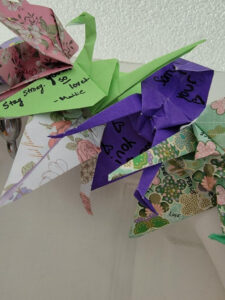
Paper cranes to be attached to the wreaths
“I feel blessed in a way because I did notice the good in the world and the good in people coming to support us and sending us their thoughts and prayers,” Heather said.
The 7/20 foundation is also raising money to make the temporary #BoulderStrong Resource Center a permanent “resiliency” center.
“It’s a place where anyone affected by the tragedy knows they can go and get free mental health counseling and participate in healing activities like yoga and tai chi,” Heather said. “One of the things we learned is that often survivors would meet up at the Aurora Strong Resiliency Center and just talk – it means so much to share your story and what you’re going through with people who have been through the same thing. A lot of times family members and friends don’t understand as deeply as you do, so you give a group like that a space to meet, even if it it’s just to have lunch.”
Aurora survivors also identified a need for support dogs, so the 7/20 foundation is fundraising to purchase one dog to donate to Boulder. A trained service dog can cost anywhere from $15,000 to $30,000.
“We want to advocate for the long-term needs of survivors by giving them their own support dog because having a dog with you when you’re talking about hard stuff is a source of comfort and calm,” Heather said. “Also, having emotional support dogs at the trial was important for family members.”
As years passed, fewer people were using the Aurora Strong Resilience Center, so it closed in mid-2019. But people’s needs are still being met, Heather said.
“The city of Aurora and Aurora Mental Health were very, very supportive and they recognized that we loved that center and it was important to the survivors who kept going there,” Heather said. “They didn’t want survivors to feel like they were saying, ‘Oh, you should be healed now, so we’re closing it down.’ That’s why they closed it in a nice, transitional way.”
The transition shifted responsibility for service referrals to the 7/20 foundation.
“Now we’re a resource center and people can ask us where to go for services,” Heather said. “Even today, if someone needs help they can call Aurora Mental Health and they will offer them free services. So, it’s important that people have access to long-term services because things will trigger people, even 10 years later.”
Those triggers include other mass shootings.
“The number one thing I’ve learned is that it becomes very difficult when another mass shooting happens because you feel like you are right back to the day your tragedy happened,” Heather said. “But the amount of love and kindness you receive by sharing just a little bit of love and kindness will drown out that darkness. So, just allowing yourself to grieve, feel sad and vulnerable, and sharing with other people actually brings the love back to you a thousand times over.”
She also underscored the importance of community involvement.
“It takes a community to heal a community,” Heather said. “What we found to be very healing is how our community stepped up and raised money for a memorial. It took step-by-step, penny-by-penny, everyone coming together and being a part of it, to build it. Maybe Boulder should think about doing that with the resilience center. It would be even more special if the community has input on things they want to see at a resilience center and things that would make them feel better.”
 English
 Spanish
 Afrikaans
 Albanian
 Amharic
 Arabic
 Armenian
 Azerbaijani
 Basque
 Belarusian
 Bengali
 Bosnian
 Bulgarian
 Catalan
 Cebuano
 Chichewa
 Chinese (Simplified)
 Chinese (Traditional)
 Corsican
 Croatian
 Czech
Czech Danish
 Dutch
Dutch Esperanto
 Estonian
 Filipino
 Finnish
 French
 Frisian
 Galician
 Georgian
 German
 Greek
Greek Gujarati
 Haitian Creole
 Hausa
Hausa Hawaiian
 Hebrew
 Hindi
Hindi Hmong
Hmong Hungarian
 Icelandic
 Igbo
Igbo Indonesian
 Irish
Irish Italian
 Japanese
 Javanese
 Kannada
 Kazakh
 Khmer
Khmer Korean
 Kurdish (Kurmanji)
 Kyrgyz
 Lao
Lao Latin
Latin Latvian
 Lithuanian
 Luxembourgish
 Macedonian
 Malagasy
 Malay
Malay Malayalam
 Maltese
 Maori
Maori Marathi
 Mongolian
 Myanmar (Burmese)
 Nepali
 Norwegian
 Pashto
 Persian
 Polish
 Portuguese
 Punjabi
 Romanian
 Russian
 Samoan
 Scottish Gaelic
 Serbian
 Sesotho
 Shona
Shona Sindhi
 Sinhala
 Slovak
 Slovenian
 Somali
 Sudanese
 Swahili
 Swedish
 Tajik
Tajik Tamil
Tamil Telugu
 Thai
Thai Turkish
 Ukrainian
 Urdu
Urdu Uzbek
Uzbek Vietnamese
 Welsh
Welsh Xhosa
Xhosa Yiddish
 Yoruba
 Zulu
Zulu